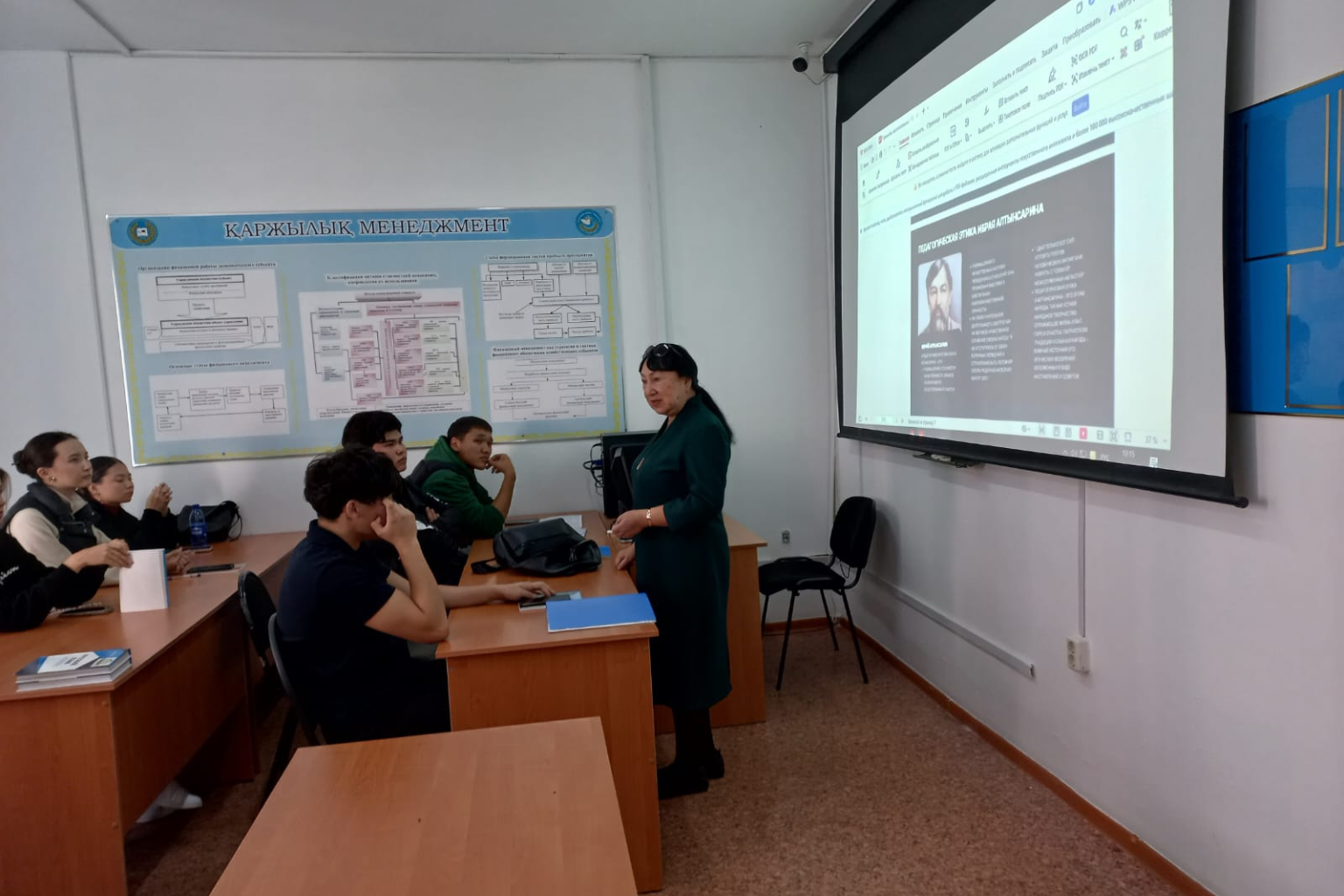
At ESIL University, a discussion on “Academic Integrity in Higher Education Through the Lens of I. Altynsarin’s Ethical Views” was held in Room 322 with first-year students majoring in Economics. The thematic discussion was conducted by E.A. Urunbasarova, F.Z. Dzhaksylykova, M.Kh. Khasenova, A.A. Utegenova, S.T. Uskenbaeva, and A.I. Kuznetsova, lecturers of the Russian Language Section of the Department of Social Sciences and Humanities. Within the Russian Language course and the topic “Literary Style,” students explored I. Altynsarin’s literary legacy and discussed the connection between the moral values reflected in his works and contemporary principles of academic integrity.
Using stories and didactic works as examples, participants examined such issues as the value of independent work, respect for intellectual property, compliance with academic rules, a responsible attitude towards learning, and the formation of personal reputation. Particular attention was paid to the unacceptability of cheating, plagiarism, and appropriating the results of others’ intellectual activities, as well as the importance of proper citation and acknowledging the contributions of other authors.
Thus, using the story “The Bai’s Son and the Poor Man’s Son” as an example, students concluded that genuine knowledge and high academic achievement are always the result of persistent personal effort. Attempts to obtain a grade the easy way—through cheating, purchasing ready-made assignments, or using someone else’s intellectual work—are equated with being “spoiled” and unable to live independently. The parable about the generous yet hardworking protagonist in the story “Atymtai’s Generosity” formed the basis of a discussion about the value of reputation. The nobility of a modern student and future economist lies in respect for others’ intellectual property. Academic integrity is an expression of respect for the work of scholars and fellow students, and a rejection of plagiarism and taking credit for others’ achievements.
The moral category of modesty and respect for rules in the story “Politeness” translates, in the university context, into strict adherence to the academic code. To be “polite” in an academic environment means to honour university rules, comply with established standards for conducting examinations, and openly acknowledge the contributions of other researchers through proper citation. The allegory of caring for trees as a process of upbringing in the story “Garden Trees” clearly demonstrated to students that academic integrity is an inner moral backbone established in the first year of study. Just as a young tree requires proper care, a future professional builds their name and scholarly worldview through honest learning, where what matters is not merely the grade but the actual quality of the knowledge acquired.
The discussion became part of the university’s work to foster a culture of academic integrity and develop students’ responsible attitude towards the educational process. Such events help raise students’ awareness of the principles of academic integrity, prevent violations of academic ethics, and strengthen the values of honesty, responsibility, and respect for others’ work.
Following the discussion, students concluded that academic integrity is not only compliance with established rules but also a conscious ethical choice that determines the quality of education, professional dignity, and reputation of a future specialist.
Holding such events reflects Esil University’s consistent efforts to develop a culture of academic integrity, integrate ethical principles into the educational process, and build an academically responsible community.